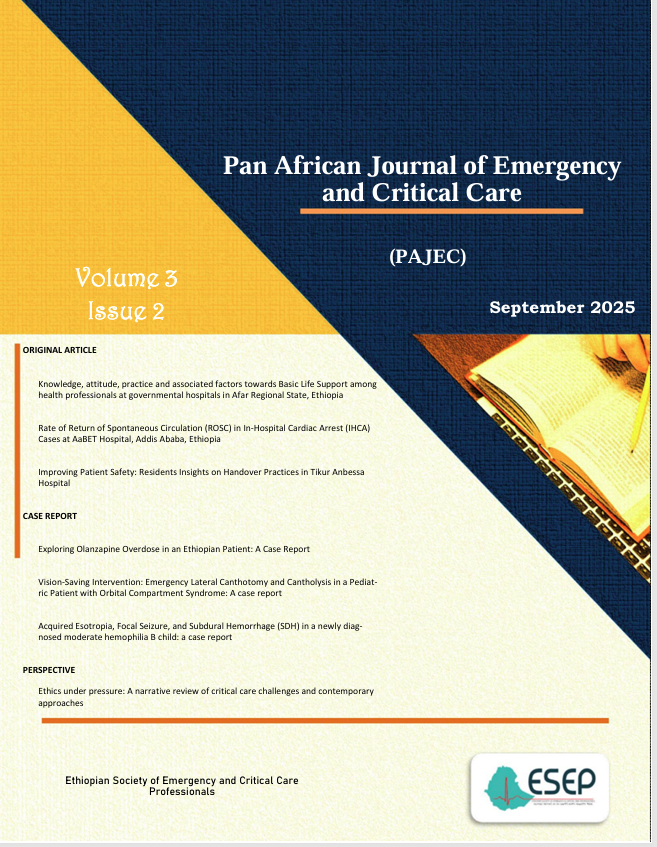
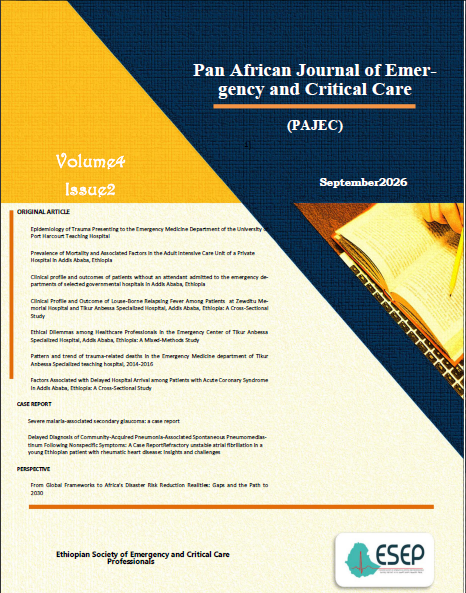
Ethical Dilemmas Among Healthcare Professionals in the Emergency Center of Tikur Anbessa Specialized Hospital, Addis Ababa, Ethiopia: A Mixed-Methods Study
DOI:
https://doi.org/10.58904/p.v4i2.301Abstract
Background: Ethical dilemmas are intrinsic to emergency care, arising from tensions among respect for patient autonomy, resource allocation, confidentiality, and end-of-life decision-making. Data on the prevalence and nature of such dilemmas from emergency departments in low- and middle-income countries, including Ethiopia, remain scarce. This study aimed to determine the prevalence, nature, and determinants of ethical dilemmas among healthcare professionals in the Emergency Center of TASH
Methods: An institution-based, cross-sectional, mixed-methods study was conducted in the Adult Emergency Center of TASH from 1 to 30 August 2025. Ninety Emergency and Critical Care Medicine (ECCM) residents and emergency nurses, selected by stratified random sampling, completed a structured, pretested questionnaire; 12 additional participants took part in two profession-specific focus group discussions. Quantitative data were summarized descriptively and analyzed by multivariable logistic regression; qualitative data were analyzed thematically and triangulated with the quantitative findings. Statistical significance was set at p<0.05.
Results: Ethical dilemmas were common: 75.6% of participants reported resource-allocation dilemmas, 70.0% confidentiality/communication dilemmas, and 62.2% end-of-life dilemmas, attributed principally to shortages of ventilators, intensive care beds, oxygen, and essential medicines, compounded by culturally influenced expectations around communication and consent. Longer clinical experience was independently associated with lower odds of autonomy-related dilemmas (AOR 0.10; 95% CI 0.01-0.52; p=0.011), whereas higher job satisfaction was associated with higher odds of resource-allocation dilemmas (AOR 5.4; 95% CI 1.2-23; p=0.02). Sex, professional role, and prior ethics training were not significantly associated with dilemma occurrence. Qualitative accounts converged on themes of moral distress, emotional exhaustion, and decisional paralysis in the absence of institutional guidance.
Conclusions: Ethical dilemmas are frequent among healthcare professionals in this emergency center and appear predominantly structural in origin. Strengthening resource availability, codifying institutional guidelines (including do-not-resuscitate policy), and embedding practical, case-based ethics training may reduce moral distress and support more consistent ethical decision-making.
Downloads
Published
How to Cite
Issue
Section
License
Copyright (c) 2026 MD - Corresponding Author. Department of Emergency and Critical Care Medicine, College of Health Sciences, Addis Ababa University, Addis Ababa, Ethiopia. ORCID: not available, MD - Department of Emergency and Critical Care Medicine, College of Health Sciences, Addis Ababa University / Tikur Anbessa Specialized Hospital, Addis Ababa, Ethiopia. ORCID: not available., MD - Department of Emergency and Critical Care Medicine, College of Health Sciences, Addis Ababa University / Tikur Anbessa Specialized Hospital, Addis Ababa, Ethiopia. ORCID: not available.

This work is licensed under a Creative Commons Attribution-NonCommercial-NoDerivatives 4.0 International License.
This is an open access article distributed under the Creative Commons Attribution License, which permits unrestricted use, distribution, and reproduction in any medium, provided the original work is properly cited.